
Contributing to PHP core means changing the actual C source code that runs on tens of millions of servers — and it is far more approachable than most PHP developers assume. This post is a complete, reproducible walkthrough of how I found, fixed, tested, and merged PR #22694 into php-src, landing in PHP 8.5. The bug: ReflectionConstant::__toString() and ReflectionClassConstant::__toString() emitted a spurious “NAN value was coerced to string” warning. The fix was four lines of C.
TL;DR
- The bug: Casting a
NANorINFclass constant to a string via Reflection printed a warning to user code, even though the Reflection extension itself did the conversion internally. - The fix: Add an explicit
IS_DOUBLEbranch that callssmart_str_append_double()instead of falling through to a generic string coercion. - The result: 34 lines added, 0 removed, 1 test file, merged into branch
PHP-8.5. - The takeaway: Contributing to PHP core is a normal GitHub workflow — fork, branch, add a
.phpttest, open a pull request.
What bug did this PHP core contribution fix?
PHP represents the special floating-point values NAN (Not-a-Number) and INF (Infinity) as doubles. When you cast one of these to a string in userland, PHP intentionally warns you, because silently turning NAN into the text "NAN" is usually a mistake in your own code.
The problem is that the Reflection extension performs that conversion on your behalf when you print a constant. Consider this snippet:
<?php
echo new ReflectionConstant('NAN');

class Demo {
    public const MY_NAN = NAN;
}

echo new ReflectionClassConstant(Demo::class, 'MY_NAN');
Before the fix, running this on PHP 8.5 produced a warning: “unexpected NAN value was coerced to string” — even though the developer never asked for a string cast. The reflection object did. Emitting a warning for an internal conversion the user did not request is a leaky abstraction, which is exactly why this was accepted as a genuine bug (GH-22683).
What was the root cause in the C source?
Inside ext/reflection/php_reflection.c, two helper functions build the string representation of a constant: _const_string() and _class_const_string(). Both switched over the constant’s value type — IS_STRING, IS_ARRAY, and so on — but had no explicit branch for IS_DOUBLE. Double-typed constants fell through to a generic conversion path that ran the same warning-emitting coercion userland does.
Because NAN and INF are doubles, they hit that fall-through path and triggered the warning.
What is the exact fix?
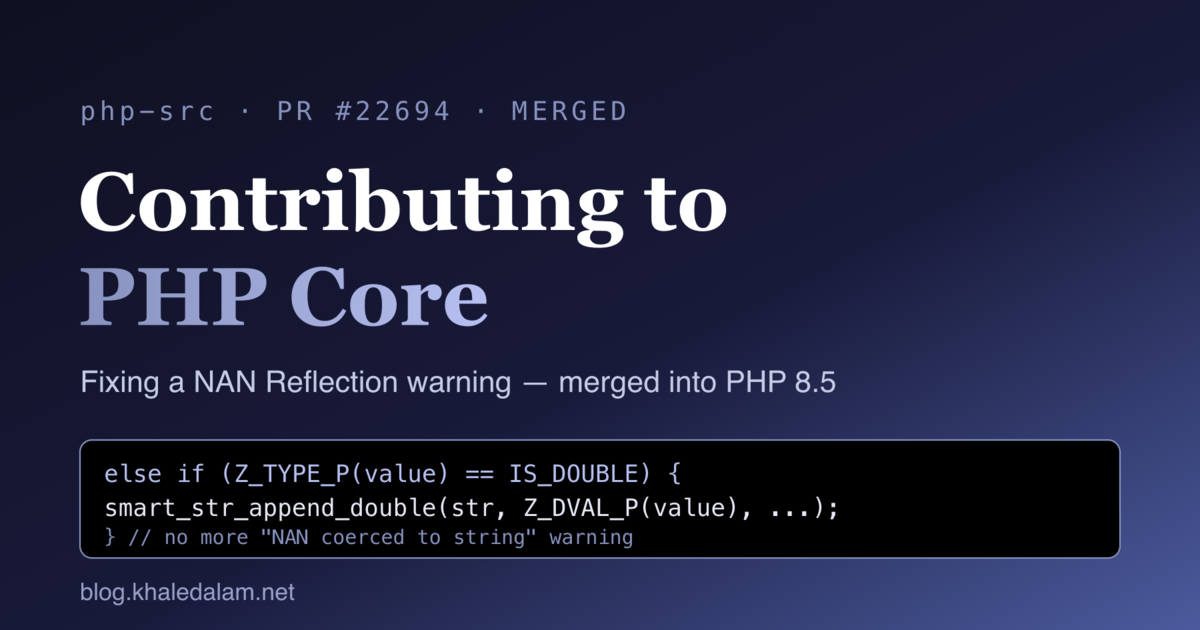
The fix adds a dedicated IS_DOUBLE branch to both functions, using PHP’s internal smart_str_append_double() helper to format the value directly — the same routine PHP uses for reliable, warning-free double formatting:
else if (Z_TYPE_P(value) == IS_DOUBLE) {
    smart_str_append_double(
        str, Z_DVAL_P(value), (int) EG(precision), false
    );
}
The trailing false argument tells the helper not to add quotes. Since smart_str_append_double() formats the double itself, the special NAN and INF values render correctly as NAN and INF with no coercion warning ever reaching user code.
Before vs. after
| Input constant | Before the PR | After the PR |
|---|---|---|
NAN |
Warning + { NAN } |
{ NAN }, no warning |
INF |
Warning + { INF } |
{ INF }, no warning |
1.5 |
{ 1.5 } |
{ 1.5 } |
2.0 |
{ 2 } |
{ 2 } |
How is the fix tested?
Every behavioral change to PHP core needs a test in the .phpt format. This PR added ext/reflection/tests/gh22683.phpt, which reflects over NAN, INF, and ordinary floats through both ReflectionConstant and ReflectionClassConstant, then asserts the output contains no warnings and formats as { NAN }, { INF }, { 1.5 }, and { 2 }. A .phpt file pins the exact expected output, so any future regression fails the CI suite immediately.
How do you start contributing to PHP core yourself?
Here is the exact workflow this PR followed. If you have ever opened a GitHub pull request, none of this is new — the only unusual part is that the codebase is C, not PHP.
- Find a real issue. Browse the php-src issue tracker for bugs labeled as confirmed or good-first-bug. A small, well-scoped bug like a spurious warning is ideal for a first PHP core contribution.
- Fork and build. Fork
php/php-src, then./buildconf && ./configure && make. Building PHP from source locally is the single biggest hurdle — once it compiles, iteration is fast. - Locate the code. Extensions live under
ext/. Reflection isext/reflection/php_reflection.c. Grep for the warning text or the function name to find the exact spot. - Write the fix and a
.phpttest. Keep the change minimal and match surrounding conventions. - Run
make test. Confirm your new test passes and nothing else breaks. - Open the pull request against the right branch. Bug fixes target the lowest supported branch that has the bug — here,
PHP-8.5. Reference the issue number (GH-22683) in the title. - Respond to review. Core maintainers review quickly when the change is small, tested, and clearly scoped.
This is my second merged Reflection patch — the first added ReflectionConstant::inNamespace(). If you want the full story of that one, read how PR #20902 was merged into PHP core. And if you enjoy language-design rabbit holes, see my RFC idea for loop unrolling via a #[Unroll(N)] attribute.
Why does a four-line PHP core fix matter?
Small correctness fixes compound. A spurious warning forces developers to litter code with @ error suppression or custom error handlers, both of which hide real problems. Removing the warning at the source means Reflection-based tooling — documentation generators, static analyzers, debuggers, and IDE plugins that introspect constants — can print float constants cleanly. That is the quiet value of contributing to PHP core: one precise change improves every tool built on top of the language.
Frequently asked questions
Do I need to know C to contribute to PHP core?
You need enough C to read the surrounding code and make a focused change. Many first contributions — like this NAN fix — are a handful of lines. You do not need to be a systems programmer; you need to be careful and to follow existing patterns.
What is a .phpt file?
A .phpt file is PHP’s native test format. It contains sections such as --TEST--, --FILE-- (the PHP code to run), and --EXPECT-- (the exact expected output). Running make test executes them and diffs actual against expected output.
Which branch should a bug-fix PR target?
Bug fixes target the oldest still-supported branch affected by the bug, so the fix can be merged up into newer branches. New features target the current development branch. This PR targeted PHP-8.5.
How long does it take to get a PHP core PR merged?
It depends on scope and reviewer availability, but small, well-tested, clearly-scoped fixes are often reviewed and merged within days. A minimal diff with a passing test is the fastest path.
Where can I find good first bugs in php-src?
Start with the php-src GitHub issues and the official Reflection documentation to understand expected behavior, then look for confirmed bugs with a clear reproduction case.
Key takeaways
- Contributing to PHP core uses an ordinary fork-branch-PR workflow; the codebase is C.
- The bug was a leaky abstraction: Reflection warned about a conversion it performed itself.
- The fix adds an explicit
IS_DOUBLEbranch callingsmart_str_append_double(). - Every behavioral change ships with a
.phpttest. - Start small: a spurious-warning fix is an ideal first contribution.
Have you contributed to PHP core, or are you eyeing your first patch? I’m @khaledalam on GitHub — I’m happy to point you at a good first bug.
 khaledalam